
Two years ago, we wrote about the then-emerging international push to keep kids off social media. Since then, there have been several legislative efforts, and public opinion has hardened. Australia blazed the trail, implementing the world's first nationwide social media ban for children under 16. Several U.S. State Governments have passed restrictions through their legislatures, and the tech companies have objected in court. We’re currently in the middle of what seems like a drawn-out contest that will almost certainly end in some system of outright restriction, parental consent and corporate responsibility.
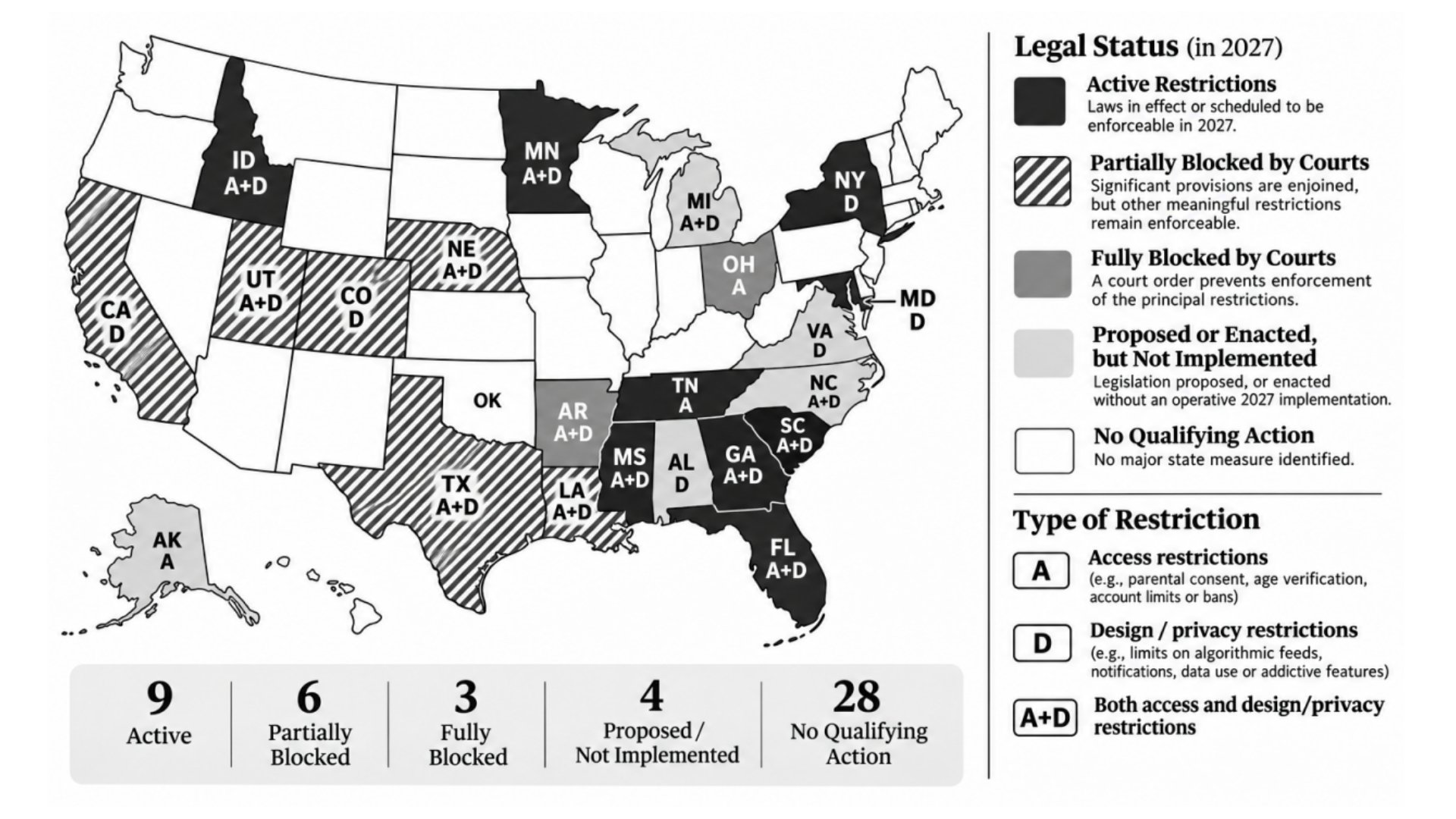
South Carolina Makes Its Move
South Carolina passed two laws this year, and they're worth taking one at a time because they do different things.
In February, Governor McMaster signed the South Carolina Social Media Regulation Act. It doesn't keep kids off the platforms. It instead focuses on how the platforms behave once kids are on them. Companies have an obligation to exercise reasonable care in how they treat minors; they face limits on collecting and using children's personal data; and they have to put guardrails around personalized recommendations, targeted advertising and the features built to keep you there, infinite scroll and autoplay chief among them.
In May, McMaster signed the Stop Harm from Addictive Social Media Act. Starting Jan. 1, 2027, platforms will need verifiable parental consent for any user under 16. They'll also have to set restrictive privacy defaults and estimate their users' ages. The law reaches the engagement machinery too, meaning algorithmic feeds and push notifications.
Neither law is an Australian-style ban. A South Carolina parent can still approve usage. What has changed is that the companies now carry obligations they didn't have before. By focusing on corporate responsibility to minors, as well as the legality of contracts with minors (those terms and conditions you scroll through when setting up an account), governments are sidestepping free-speech objections and passing legislation that is more likely to hold up in court.
The votes reflected just how one-sided public opinion is at the moment. The May bill cleared the House 115–0 and the Senate 42–1.
Our Neighbors Are Pushing Too
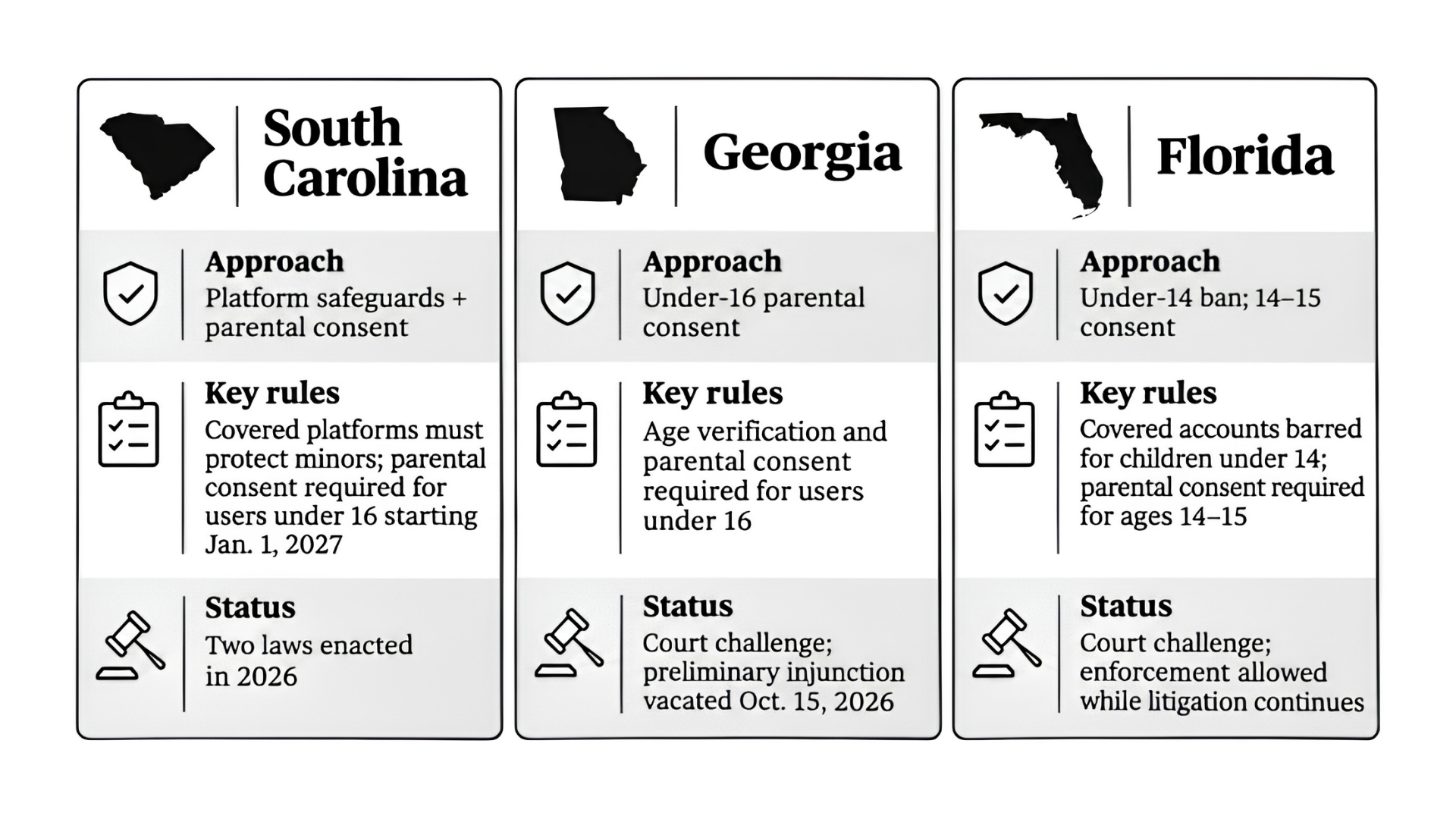
South Carolina is not the only state whose parents read Jonathan Haidt’s The Anxious Generation. Florida's HB 3 bars children under 14 from using social media accounts and requires parental consent at ages 14 and 15. Georgia's SB 351 requires age verification and parental consent for users under 16. Tech industry groups sued both states on First Amendment grounds, as they usually do, and until recently, the industry usually won.
Then came this October. On the 14th, the Eleventh Circuit Court of Appeals concluded that Florida's restrictions are likely constitutional. The next day, it threw out the preliminary injunction that had been blocking Georgia's law.
Two important caveats. Neither case is over, and South Carolina sits in a different circuit, the Fourth, so none of this binds the court here. Still, when we wrote in 2025, the courts seemed like a wall, and now that wall is crumbling.
The Public Is On Board. But Does It Work?
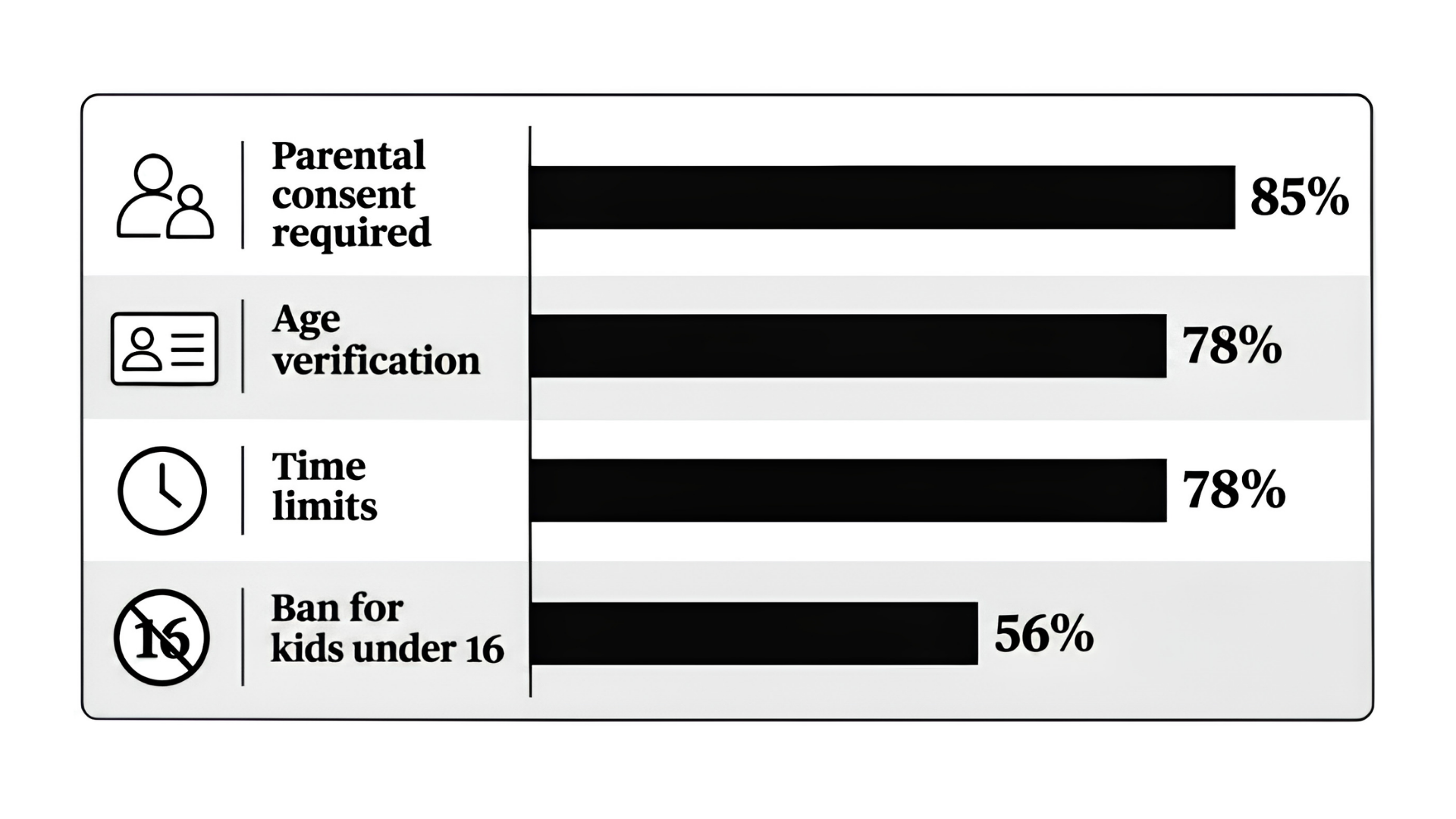
On this topic, the public is united. A July 2026 Pew Research Center survey found that 85% of American adults support requiring parental consent before a minor opens a social media account. Age verification and time limits get 78%. An outright ban for under-16s is a harder sell, and it still gets 56%.
Popularity, though, is a separate matter from whether the thing works. That brings us back to the early mover, Australia.
After the ban took effect, Australia's eSafety Commissioner reported nearly 5 million accounts removed. The July 2026 evaluation is a little more sobering. The share of under-16s with social media accounts dropped from 52% to 42%. That's a significant decline, but it also means that about four in ten kids still had accounts months into a national ban.
The hopeful interpretation is that the ban is still new, enforcement is ongoing and bad habits are hard to kick. It can be hoped that fewer kids will join in the first place, creating downward pressure in the long term. Also, if they can continue to reduce the number of minors on social media, those who remain will hopefully have fewer reasons to engage and keep their accounts open. Perhaps 0% is impossible, but less is still more.
The End Of The Feed
The court of public opinion is adjourned. What’s left is enforcement and whether a government can make rules that stick without running over constitutional protections or creating a privacy problem of its own. Age verification is the obvious example. To prove who's a kid, you have to check everyone, which may mean collecting sensitive personal information from millions of users, adults included. Keeping minors off platforms altogether raises fair questions about free expression and access to information. Congress is working on it at its own pace. The House passed the KIDS Act in June, and the Senate is working on its own KOSA Act. They’re alike in intention, but differ in approach, and neither seems ready to pass. A full federal framework seems elusive, for now, but with the 2028 elections now on the horizon, don’t be surprised to hear candidates pushing hard for some kind of federal regulation. South Carolina becomes the next test in 2027 of whether a state can protect children, respect parents and preserve individual liberty all at once. Two years ago, we called this movement a beta test. Since then, Australia has shipped, the courts have started rethinking the rules, and our own state has signed on. Governments are going to regulate how children use social media. That much is clear. More online natives are getting elected, and the troubling data regarding minors on social media is widely known. Social media founders are being pilloried in the press, in movies and on their own platforms. How it will unfold is a mystery, but here’s our prediction: the federal government will pass legislation that focuses on safeguards and parental controls, states will draw deeper restrictions, including outright bans and parental consent requirements, and schools will increasingly ban cell phones. We expect this will be mostly in place by 2030. By 2040, it’ll be old news.
