
The Rise of PR Authority
As search becomes answer-driven, the brands that shape trusted sources will shape the answer.Three takeaways
More searches are ending with AI Summaries rather than website clicks.
As Google and ChatGPT answer more questions directly, ranking matters less than being a source they trust.
That makes PR more valuable not as a vanity layer, but as part of the infrastructure of discoverability.
In communications circles, one Gartner prediction is spreading fast: by 2027, the mass adoption of public LLMs as a replacement for traditional search will drive a 2x increase in PR and earned-media budgets.[1] As a PR firm, this is obviously welcome news to us, but the underlying logic deserves attention.
The question is not whether SEO is dead or whether Google is losing its grip on search; it’s not, and they’re not. The better question is: what determines visibility when discovery becomes answer-driven rather than click-driven?
On that question, the U.S. data points in a clear direction. Search traffic remains strong. Google’s traffic remains enormous, substantially higher than the sum of all the LLMs. What is changing is where that search traffic is landing. Most searches now stop on the results page. AI summaries are answering more questions. More users are receiving what feels like a finished answer before they ever reach a brand’s website. And yes, indeed, LLM usage is quickly growing.
Search is Not Disappearing. The Click is.
SparkToro’s 2024 U.S. clickstream study found that 58.5% of Google searches ended without a click.[2] Search Engine Land’s summary of March 2025 Datos data points in the same direction: organic click share fell to 40.3% from 44.2% a year earlier, while zero-click behavior and clicks to Google-owned properties both rose.[3]
That distinction matters. Americans are not abandoning search engines. Google is simply capturing more of the interaction on its own surface. Visibility no longer belongs only to the pages that ranked best. It belongs to the source environment that informed the answer.
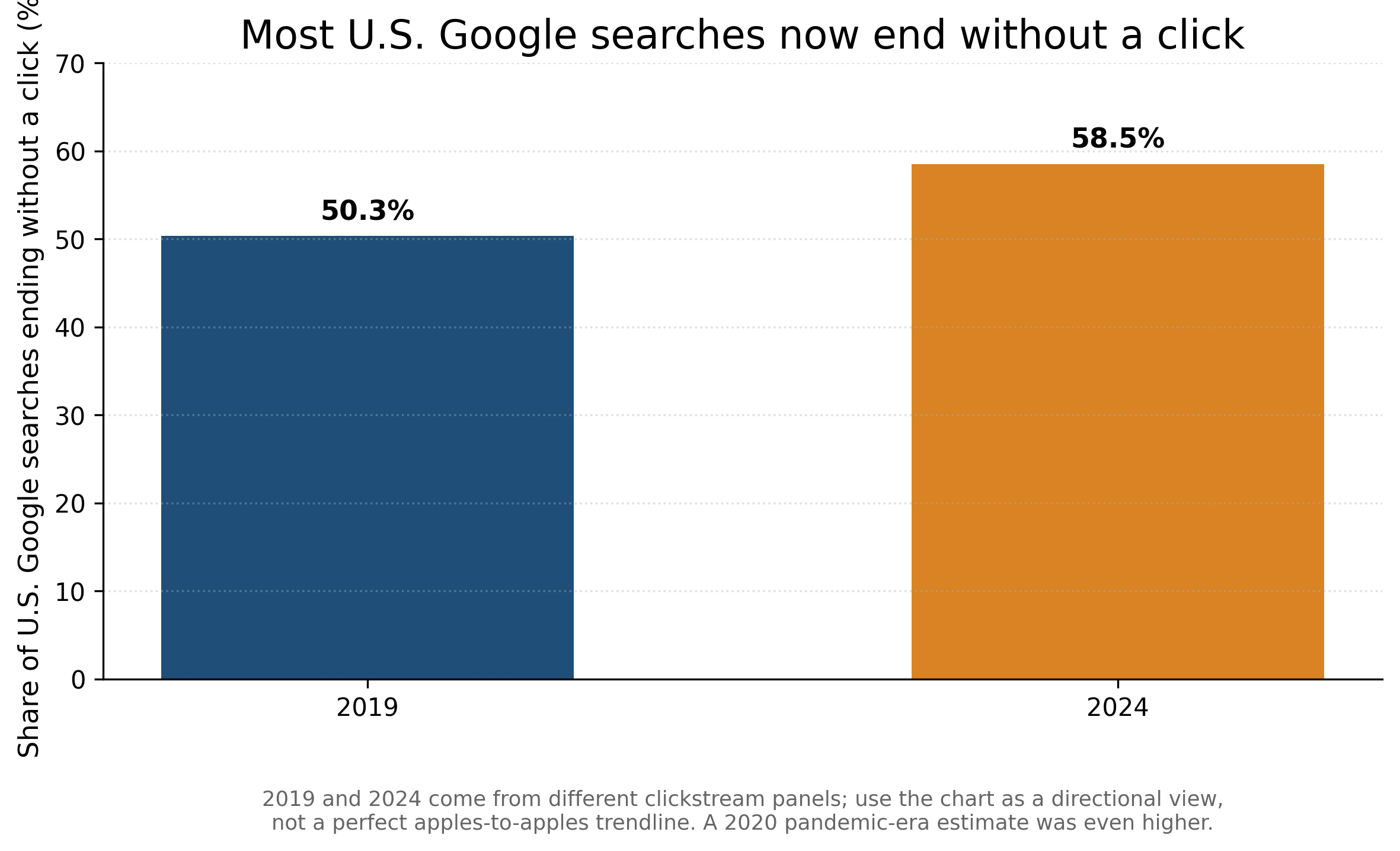
Figure 1. U.S. Google searches ending without a click, 2019 vs. 2024. Treat the chart as directional because the two studies use different clickstream panels.[2][3]
AI Summaries Accelerate the Shift from Clicks to Citations
Pew Research Center’s March 2025 browsing-data study clarifies what’s going on. AI summaries appeared on 18% of Google searches. When they did, users clicked a traditional result only 8% of the time, versus 15% when no AI summary appeared. Users clicked links within the summary just 1% of the time, and those who did were more likely to end their browsing session altogether.[4]
That is the clearest evidence yet that search is becoming an answer layer rather than a directional layer, as it has been since the days of Ask Jeeves. In other words, the search engine is no longer just helping users find the destination. Increasingly, it is the destination. With growing competition from LLMs, there is every reason to expect that this is the direction forward.
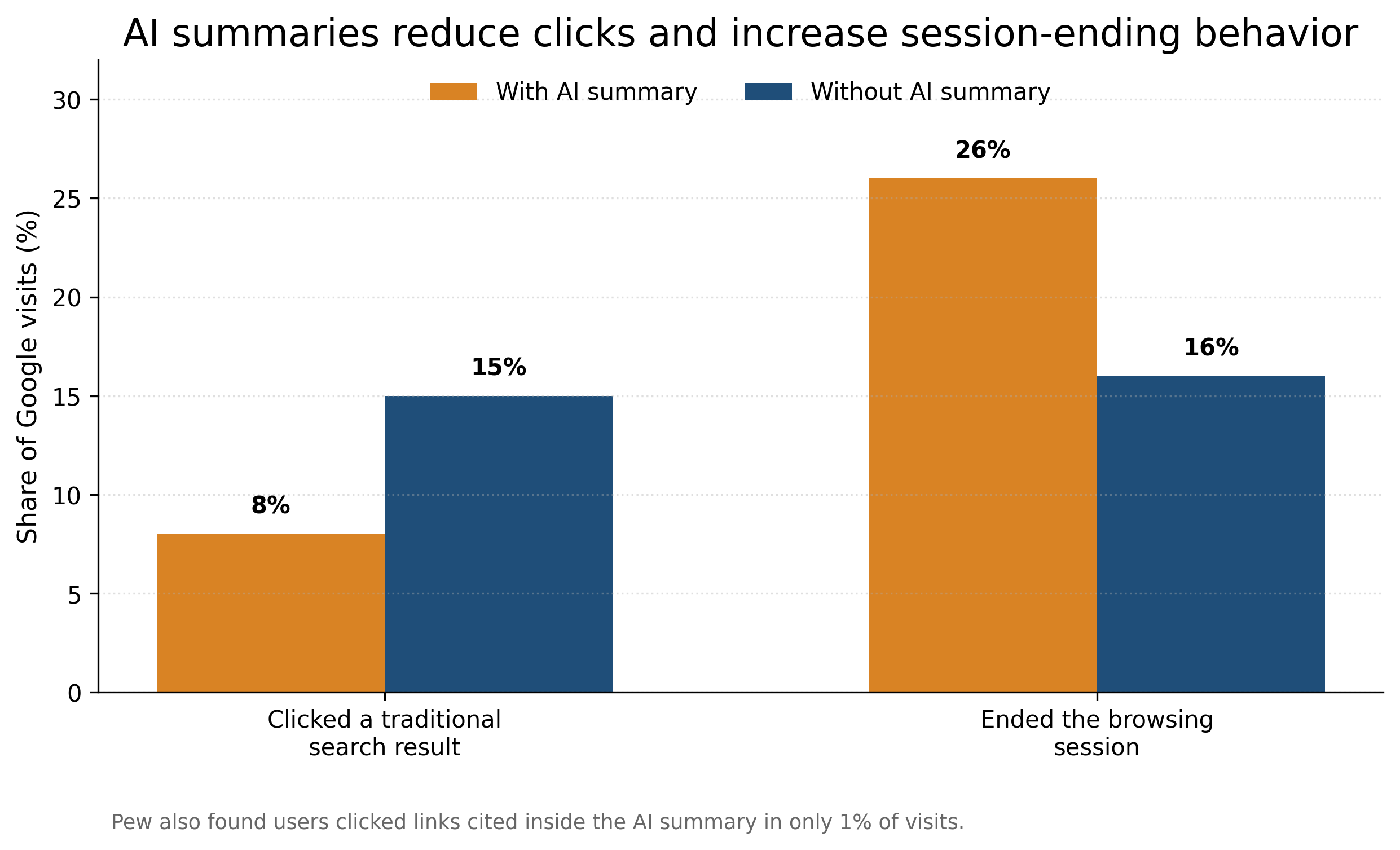
Figure 2. Google visits with AI summaries produce fewer traditional result clicks and more session ends than visits without them.[4]
From Ranking to Representation
For years, the core search question was straightforward: how do we rank high enough to win the click? That question still matters, especially for high-intent commercial queries. In answer-driven search, the increasingly important question becomes: when Google, Gemini, ChatGPT, or Perplexity synthesizes a response, whose reporting, evidence and authority are represented?
This is where PR enters the frame. AI systems read far and wide. Pew found that Wikipedia, YouTube and Reddit were the most frequently linked sources in Google AI summaries, while government sites appeared more often in AI summaries than in standard results.[4] Other vendor studies disagree on the exact citation mix. Muck Rack’s July 2025 analysis of more than 1 million AI-cited links found that over 95% came from non-paid sources, with 27% from journalistic content, and closer to half when the question involves recent news or developments.[5] Yext’s October 2025 analysis of 6.8 million AI citations, by contrast, found 86% came from brand-managed sources such as websites and listings.[6]
Obviously, those studies are not perfectly aligned. But they still point to the same strategic conclusion: the brands most likely to shape AI answers are not relying on a single signal. They have a broad authoritative footprint, including earned coverage, structured content, consistent data, expert commentary, reviews and other signals that corroborate one another.
PR Comes First
PR’s role in this new system is easy to underestimate because many still think of it as a finishing touch rather than a core practice. In an answer-driven world, PR creates visibility.
Press coverage matters because of the people who read it and the machines that read it. When AI tools summarize a topic, they draw on sources that appear trustworthy. That’s why expert quotes, interviews and contributed articles matter in a new way. They influence how a company is described and understood.
In that sense, PR is part of how companies get discovered, not just something that happens after they are. SEO still matters. But visibility increasingly depends on signals PR has always helped build: trust, credibility and third-party validation.
Younger Users Adapt First
The demographic story provides supporting evidence for understanding the pattern.
Pew reports that 58% of U.S. adults under 30 have used ChatGPT, versus 10% of adults 65 and older.[7]
Younger adults are also more likely to find AI summaries useful.[8]
Upper-income Americans report more trust in AI summaries than lower-income Americans.[8]
What Companies Should Do Next
Define what you want to be known for: the core ideas you want associated with your business, what you do best, what someone should understand about your brand.
Ensure those ideas show up everywhere. Your website, media coverage, interviews and social channels should all reinforce the same message. The goal is consistency.
Treat every piece of coverage as valuable.
PR strategy now needs to connect more directly with search, analytics and content strategy. Think of PR as the central nervous system of your brand positioning, organizing all of the parts.
Conclusion
The growing value of PR reflects a broader shift: authority is becoming a primary driver of discoverability.
As the user journey changes with AI-powered summaries, overviews and chat responses, the winning brands will be the ones that are easiest for those systems to quote, summarize and trust. That comes from disciplined narrative development, credible earned coverage, consistent proof points and active management of how a brand is represented across the web.
Source notes
[1] PRmoment.in "Gartner predicts a 2x surge in PR and earned media budgets by 2027 — and it’s reshaping the function," Feb. 20, 2026.
[2] SparkToro / Datos, "2024 Zero-Click Search Study: For every 1,000 EU Google Searches, only 374 clicks go to the Open Web. In the US, it’s 360," July 1, 2024.
[3] Search Engine Land, "Zero-click searches rise, organic clicks dip: Report," June 13, 2025.
[4] Pew Research Center, "Google users are less likely to click on links when an AI summary appears in the results," July 22, 2025.
[5] Muck Rack, "What is AI reading? Takeaways from a report on AI brand visibility," updated Oct. 24, 2025; see also Nieman Journalism Lab, July 24, 2025.
[6] Yext Research, "AI Citations, User Locations, & Query Context," October 2025.
[7] Pew Research Center, "34% of U.S. adults have used ChatGPT, about double the share in 2023," June 25, 2025.
[8] Pew Research Center, "Americans have mixed feelings about AI summaries in search results," Oct. 1, 2025.